
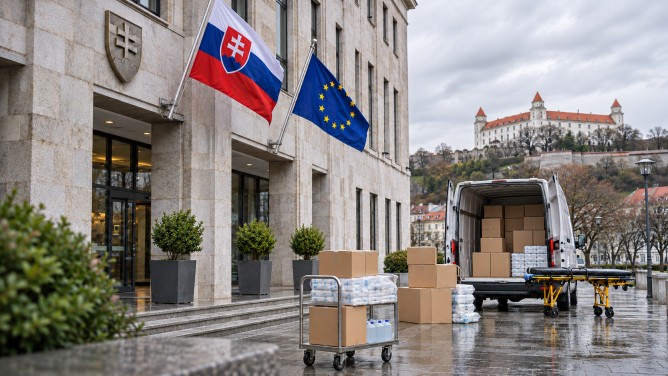
Slovakian Prime Minister Robert Fico has announced that Slovakia will not participate in the European Union’s proposed €45 billion loan programme for Ukraine, emphasizing the country’s stance against financial support linked to the ongoing conflict. Despite this decision, Fico affirmed that Slovakia would continue to provide humanitarian aid to Ukraine.
The decision aligns with Slovakia’s earlier position when it declined to join a previous €90 billion EU loan package. Fico’s announcement comes amid pressure from German Chancellor Friedrich Merz, who has urged EU member states to increase their financial commitments to Ukraine beyond 2027. However, Fico reiterated that Slovakia’s stance would remain unchanged, arguing that military-related financial aid could potentially extend the conflict.
This divergence of opinion is expected to be a topic of discussion among leaders from Slovakia, Poland, Hungary, and the Czech Republic, along with Austria’s chancellor, at a meeting in Bratislava scheduled for November 23. The issue also precedes the upcoming EU summit in Brussels on November 26-27, where European leaders will deliberate on the bloc’s proposed €1.78 trillion budget for 2028-2034, which includes a reserve for supporting Ukraine.
Slovakia’s decision highlights the growing differences among European governments regarding the financing of Ukraine’s future needs and the distribution of financial responsibilities among EU member states. As the EU grapples with these internal disagreements, the bloc faces the challenge of maintaining a unified approach to supporting Ukraine amid ongoing geopolitical tensions.