
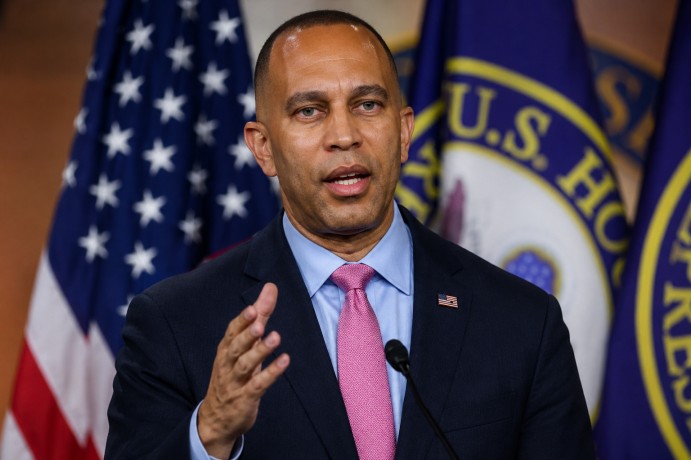
Senior Democrats in the House of Representatives have taken a firm stand against a Republican proposal that seeks to halt $3.3 billion in U.S. aid to Israel, underscoring a significant rift within the party regarding support for the nation. House Minority Leader Hakeem Jeffries announced his intention to vote against the amendment introduced by Republican Representative Thomas Massie, citing concerns over its broad implications. Jeffries warned that the measure could inadvertently disrupt humanitarian aid and weaken efforts to combat militant groups like Hamas and Hezbollah.
Alongside Jeffries, House Democratic Caucus Chair Pete Aguilar voiced his opposition to the proposal, although he noted the necessity of reevaluating U.S.-Israel relations. Aguilar expressed concerns that Israel’s current policies have increasingly isolated it within the region. In contrast, Greg Casar, Chair of the Congressional Progressive Caucus, encouraged lawmakers to back the amendment. Casar argued that U.S. taxpayer funds should no longer support Israel’s military actions, urging the Democratic Party to reconsider its stance on the Israeli-Palestinian conflict.
The debate arises amid growing demands from voters and progressive members of Congress for the U.S. to alter its policy toward Israel, especially in light of the ongoing conflict in Gaza. This internal party division reflects the broader conversation about how the U.S. should engage with Israel and the Palestinian territories, particularly regarding military aid and humanitarian concerns.
Jeffries emphasized the need for a “major reset” in relations between the U.S. and Israel, advocating for a balanced approach that supports Israel’s right to exist while also endorsing the creation of a Palestinian state. He suggested that future U.S. military aid should adhere to human rights standards and take into account Israel’s capacity to fund more of its own defense requirements. This perspective aims to bridge security interests with ethical considerations, potentially reshaping the dynamics of U.S. involvement in the region.